Tuesday, May 11, 2010

Charles and Emma: The Darwins' Leap of Faith, by Deborah Heiligman

Charles and Emma: The Darwins' Leap of Faith, by Deborah Heiligman. New York: Henry Holt and Company, 2009. ISBN-10: 0805087214; ISBN-13: 978-0805087215. 272 p.

Plot Summary
This biography of Charles Darwin focuses more on his relationship with his wife, Emma, than on his famous travels on the HMS Beagle. Charles faced constant doubts about religion, an afterlife, and God's role in creating the earth--heretical notions in Victorian England. Emma Darwin, though she also had her doubts about some tenets of organized religion, was devoutly Christian, and determined that she would be with her beloved family in heaven. This story tells of the adjustments both had to make as they built a life together.

Critical Evaluation
Many biographies have been written about Charles Darwin, but most accounts of his life focus on his scientific discoveries, not his family. Heligman's approach is fresh and fascinating. Despite their religions differences, Heiligman makes it clear that Charles and Emma Darwin were well-matched and lived a happy life. The New York Times review says that "In today’s climate of division between religion and science, it’s instructive to read about a marriage in which the two cultures improved each for exposure to the other. Heiligman’s most revealing insight comes near the end of the book, as Darwin, having developed his ideas in private for 20-some years, spends a feverish 13 months writing them up in “The Origin of Species.” Without Emma, he might well have written a combative, antireligious treatise — “The God Delusion” of his day. Instead, his experience with his wife’s tolerant, reasonable brand of faith led him to temper his tone"(link). This book was a finalist for the 2010 National Book Award and a 2010 Printz Honor Book, as well as a recipient of YALSA's first-ever Excellence in Nonfiction Award.

Reader’s Annotation
Charles Darwin was a man of science, whose ideas on the origin of species were considered heretical by many religious people. His wife Emma was a religious woman of faith who believed strongly in God's creation of the earth and a heaven after death. How did two people who were so different build a happy life together?

Author Information
Deborah Heiligman was born and raised in Allentown, PA. She majored in religious studies at Brown University--she considered becoming a rabbi for about a week, but then had no idea what she wanted to do after graduation. She says, " I wanted to be a writer, but I didn't think real people were writers. I thought writers were like movie stars and that regular people like me couldn't be writers. At Brown all the people who said they were going to be writers wore all black, smoked lots of cigarettes (something I never did: my father was a lung doctor!), drank endless cups of coffee, and used such big words I couldn't understand what they were saying (I don't think they knew what they were saying either). My bet is that most of those people are lawyers or stockbrokers or maybe ski bums. Anyway, I bet they're happy. And so am I."

After college, Heiligman worked for a short time at MOMENT magazine, then got a job at the Scholastic News Explorer, writing articles for kids in grades 1 through 6. She says it was the best job she could have ever had, but doesn't regret quitting in 1985 to take care of her newborn son. She's published numerous articles in magazines such as Parents and Ladies' Home Journal, and has published over 25 children's books (source). She is married to the author Jonathan Weiner, who won the Pulitzer Prize in 1994 for his book The Beak of the Finch (about evolutionary biology, specifically in the finches Charles Darwin studied in the Galapogos Islands) and now teaches science writing at Columbia University's Graduate School of Journalism (source).

Genre
Nonfiction.

Curriculum Ties
Science: Darwin's theory of evolution
History: Victorian England

Booktalking Ideas
-What do you know about Charles Darwin? Discuss his scientific legacy.
-Share Darwin's famed list debating the merits of marrying vs. not marrying.

Reading Level/Interest Age
Grades 8-12 (Booklist)

Challenge Issues
None, content wise. Some may wish to ban it because it discusses the theory of evolution, which is still a point of contention among some religious fundamentalists.

I included this book because it received good reviews and seemed interesting.

The Monstrumologist, by Rick Yancey

The Monstrumologist, by Rick Yancey. New York: Simon and Schuster BFYR, 2009. ISBN-10: 1416984488; ISBN-13: 978-1416984481. 454 p.

Plot Summary
"mon-strum-ology. n. 1: the study of life forms generally malevolent to humans and not recognized by science as actual organisms, specifically those considered products of myth and folklore. 2: the act of hunting such creatures."

During the late 1800s, Will Henry is the orphaned assistant of Dr. Pellinore Warthrop, a man who has devoted his life to the study of monsters. Will, like his father before him, has seen plenty of gruesome scenes as he assists with necropsies in Dr. Lathrop's basement laboratory, but nothing can prepare him for the horrors that are about to come. The Anthropophagi--headless monsters with sharp teeth in their bellies, who impregnate and then feed on humans, have been discovered in North America. As they begin to prey on a New England town, can Will and Dr. Warthrop discover a way to defeat these monters and keep their town safe?

Critical Evaluation
Rick Yancey spends a lot of time setting the scene and presenting the history of human interaction with the monsters, but the tension he spends time building develops into a nail-biter of a climax. Yancey attempts to imitate the Victorian language of classic horror such as Frankenstein and Dracula. On the whole, he succeeds, although his excessive use of alliteration sometimes seems forced. Yancey's exploration, not only of the horror of monsters, but of the downsides of unfettered human ego and vanity, starts slow, but ends up being a great read.

Reader’s Annotation
Will Henry is the orphaned assistant to a scientist who studies monsters. When a group of violent, bloodthirsty monsters is discovered in New England and begins stalking the residents of a small town,Will discovers the horrors that human vanity and pride can cause.

Author Information
Rick Yancey knew he wanted to be a writer since he was a child in Florida. He earned an English degree from Roosevelt University in Chicago, and then returned to Florida, where he taught and did some theatre work. He then began working as a revenue officer for the IRS, and eventually worked there for 10 years. However, he kept writing, and was able to leave the IRS after the publication of his memoir, Confessions of a Tax Collector, in 2004. He has published six novels in addition to his memoir, including the Alfred Kropp trilogy for young adults and the Teddy Ruzak mystery series for adults. He lives in Florida with his wife and three sons (source). His website is www.rickyancey.com.

Yancey realized he wanted to be a writer in middle school. He says, "a teacher assigned a five-page narrative paper and I turned in 25 pages! I wrote a note to him, apologizing for the length, and he wrote back, “Never apologize for something you should be proud of.". He says his wife is the greatest influence of his writing career. "[She] knew how much the dream of being a professional writer meant to me and dreamed for me when I lost all hope. She rescued manuscripts from the trash, gave me pep talks and bought books to encourage me. She's my biggest fan and toughest critic."

Genre
Gothic horror

Curriculum Ties
English: A modern companion to be read with classic horror novels such as Dracula or Frankenstein to help teens learn to analyze the gothic horror genre.

Booktalking Ideas
-Read the passage where a monster explodes out of a cemetery grave to kill its first victim. It's gruesome and bloody, and will immediately set the scene and grab the interest of teens who like such things.

Reading Level/Interest Age
Grades 9-12. While the protagonist is a 12 year old boy, I would hesitate to recommend it to younger teens because of the graphic, gruesome violence the monsters inflict on humans during the course of the story.

Challenge Issues
Gory, graphic violence, similar to that of Stephen King.

I included this book because it was a 2010 Printz Honor Book, and it was also recommended on the blog A Chair, a Fireplace, and a Tea Cozy.

The Evolution of Calpurnia Tate, by Jacqueline Kelly

The Evolution of Calpurnia Tate, by Jacqueline Kelly. New York: Henry Holt and Co., 2009. ISBN-10: 0805088415; ISBN-13: 978-0805088410. 340 p.

Plot Summary
The summer of 1899 is a hot one in Texas. Calpurnia Tate is the only daughter of even children, and to keep cool she spends a lot of time at the river with her grandfather. An avid naturalist, he helps Calpurnia develop a love of nature and the sciences of biology and botany. But Calpurnia, as a girl at the turn of the century, is expected to spend her time learning to cook doing needlework, and learning the other feminine skills she will need before she comes out as a debutante. Can Calpurnia balance her duties as the family's only daughter with her ambition and scientific temperament?

Critical Evaluation
Calpurnia Tate is a delightful character. Kelly does an excellent job at evoking a specific time period, from the excitement surrounding the first telephone and automobile in town to the time-consuming nature of household chores like laundry and cooking. I loved this book, although I was a little disappointed that Calpurnia's questions about how to balance her desires with others' expectations wasn't really answered. Part of the appeal of this story, I think, is that it tries to answer her questions in a realistic way--just because she wants to be a botanist doesn't mean it will really be possible for her in 1899 society, but she's going to try her best to make it happen. Calpurnia's strong voice and determined interests make this story fly by.

Reader’s Annotation
The summer of 1899 is hot in Texas, and Calpurnia Tate spends her time learning about biology and botany from her naturalist grandfather. But as a girl, can Calpurnia balance her scientific curiosity with the expectations of womanly behavior?

Author Information
Jacqueline Kelly was born in New Zealand but raised in Canada. She moved to Texas to attend college in El Paso, then went to Galveston to complete medical school. (It's obvious that her time in Texas intimately influenced the setting and details of Calpurnia Tate). She practiced medicine for many years, but then decided it was time for a career change and attended law school at the University of Texas. After practicing law for a few years, she decided to spend her time writing fiction instead (source). The Evolution of Calpurnia Tate is her debut novel, and was a Newbery Honor book.

When asked about her writing process, Kelly shared the following: "This book was inspired by a summer sojourn in my big old 120-year-old farmhouse in Fentress, Texas. With the thermometer almost boiling over, I began to wonder how people stood the heat a hundred years ago with no air conditioning, especially since they had to wear all those clothes. Callie and her entire family sprang to life at that moment. The book was also inspired by the sight of a big yellow grasshopper and a small green grasshopper sunning themselves on one of the window screens. They looked so different that I wondered if they were different species or not. I spent a lot of time trying to figure this out but never could.  Alas, the grasshoppers have refused an interview....I wrote a lot of this novel longhand, sitting on an old cushion on the front steps in Fentress, like Callie making her morning list of creatures" (source).

Genre
Historical fiction

Curriculum Ties
History: Early 1900s American life
Science: History of scientific theories, the ways science was practiced 100 years ago

Booktalking Ideas
Describe the setting--first telephone, first car, first time Calpurnia makes her own apple pie. The setting is so different from today that it will interest booktalking listeners.

Reading Level/Interest Age
Amazon says that this book will really appeal to 9-12 year olds, but I think that the language may be a little difficult for younger readers to get through. I feel strongly that this book could appeal to the older teen reader--while Calpurnia is a younger protagonist, her concerns can still resonate strongly with today's teen girls.

Challenge Issues
None.

I included this book because it appeared on the ALA's 2010 Best Books for Young Adults list. It also sounded really interesting in reviews I've read in various places on the Web.

A Great and Terrible Beauty, by Libba Bray

A Great and Terrible Beauty, by Libba Bray. New York: Delacorte Press, 2003. ISBN-10: 0385730284; ISBN-13: 978-0385730280. 403 p.

Plot Summary
Gemma Doyle has been sent to the Spence Academy in London after her mother's mysterious death near their home in India. Gemma has a hard time getting to know the other girls at Spence, but she isn't completely along--she's been followed from India by a mysterious young man who warns her to close her mind to the visions she has seen since her 16th birthday. As she becomes more aware of her powers, she becomes entangled with both the popular girls at school and a shadowy group called the Order. Does her destiny with the Order's magical world?

Critical Evaluation
It's clear that Bray conducted fairly extensive research about life in Victorian England. Girls during this era were groomed to become rich men's wives, and their opinions generally weren't valued by society at large. Bray's large female cast reflects different attitudes and perspectives on Victorian female roles, and even if this were solely a historical novel it would be a great read. The fantasy element only improves the book by providing an avenue to explore gender roles in even more detail as well as advancing the story. The setting, characters, and background behind the novel make it very enjoyable.

Reader’s Annotation
Gemma Doyle was sent to the Spence Academy after the tragic death of her mother. As she makes her new home in Victorian England, she starts having visions of another world.

Author Information
Libba Bray grew up in Texas, the daughter of a Presbyterian minister. When she was 18, she was in a bad car accident and had 13 surgeries in 6 years to rebuild her face (she has an artificial left eye because of it). She says her three worst habits are "overeating, self-doubt, and the frequent use of the "f" word" and she hates donuts. When she doesn't write, she says she feels depressed and cranky and itchy, so she writes so everyone around her is happy that she's stopped complaining (source). Her most recent book was Going Bovine, which won the 2010 Printz Award. A complete biography can be found on her website at http://www.libbabray.com/LBAutobiography.html.


While A Great and Terrible Beauty is sometimes categorized as chick lit, Bray says she hates the term because it's demeaning. "By and large, the writing of men is not categorized and compartmentalized in this way beyond specific publishing genres, i.e., mystery, horror, science fiction. I have the same problem when movies are referred to as chick flicks. It's dismissive; it says that the themes that often show up in women's novels and films and the perspective of women artists are somehow less than....Now, that said, can we please, please move away from this recent spate of navel-gazing, whining, shopping-obsessed superficial novels in which guys are just accessories like the right shoes, and the deepest feelings encountered are a sort of self-absorbed sulkiness on the part of the heroine? Puh-leeeze" (source).  Her strong feminism and individualism is apparent in her work.

Genre
Gothic fantasy, historical fiction

Curriculum Ties
History: gender roles in Victorian England.

Booktalking Ideas
Evoke the setting by using the passage and description of the time Gemma first sees Spence.

Reading Level/Interest Age
Grades 9-12.

Challenge Issues
Occult/magic issues.

Challenge Defense
Invite the challenger to read the book before making a value judgement.

I included this book because it was named a 2004 Best Book for Young Adults by YALSA. I also saw it at Target as I was browsing and it looked interesting.

The Amazing Adventures of Kavalier and Clay, by Michael Chabon

The Amazing Adventures of Kavalier and Clay, by Michael Chabon. New York: Picador, 2000. ISBN-10: 0312282990; ISBN-13: 978-0312282998. 656 p.

Plot Summary
Joe Kavalier, a Jewish art and practitioner of Houdini-esque escape, has just managed to escape Nazi-occupied Prague and moved to New York City. His cousin Sammy Clay, a Brooklyn-based comic book writer, chooses Kavalier as his partner in the development and production of this new novelty art form. Together, they create such characters as The Escapist, the Monitor, and Luna Moth (inspired by Rosa Saks, a woman who will influence both men throughout their lives). As they navigate life during World War II, they attain amazing professional success, but have more difficulty with their personal lives.

Critical Evaluation
From the first pages of this ambitious noel, it's clear the reader is in the hands of a master. CNN.com describes it as a "grand novel about dreamers selling dreams, reminding us that part of the thrill of dreaming is not the dream itself, but the realization that we can dream" (link). New York magazine's review admits, "I'm not sure what the exact definition of a 'great American novel' is, but I'm pretty sure that Michael Chabon's sprawling, idiosyncratic, and wrenching new book is one." At turns melancholy, joyful, and nostalgic for the Golden Age of comics, Chabon's Pulitzer Prize-winning novel is a gem.

Reader’s Annotation
Jo Kavalier and Sammy Clay are comic book artists living in 1940s New York. As they help build comic books as an art form, they grow up and deal with emotions of love, jealousy, and hatred as they work together.

Author Information

Michael Chabon was born in Washington, D.C., and grew up in the suburbs of Columbia, Maryland. He deeply loved comic books as a boy--his grandfather had been a typographer at a plant where comic books were printed, and would bring home bags of free comics for Chabon's father. His dad thought it was normal that his son should also grow up reading comic books (source). While working on a masters' program at UC Irvine, his thesis was the manuscript for Mysteries of Pittsburgh. Chabon didn't know it, but his thesis advisor submitted it to several publishing houses, and it was accepted for an advance of $155,000 (a colossal sum for a first novel by an unknown author). Chabon is married to the author Ayelet Waldman, and they and their four children live in Berkeley, CA.

In an interview with Powell's Books, Chabon said, of Kavalier and Clay, that "I definitely had a desire to try something bigger, but I've had that desire for a while. I'd tried once before to do this kind of a book. After I wrote The Mysteries of Pittsburgh, I worked on a novel called Fountain City for more than five years. Like this book, it had multiple points of view and took place over a fairly long period of time; it changed locales from one continent to another, all those kinds of things. And I failed. I had to abandon it....I wanted to do something more ambitious. Jonathan Yardley's review of Wonder Boys in The Washington Post was very kind and generous - he liked the book - but he closed the review with a paragraph where he sort of clapped his hand on my shoulder and said, "You've done well, but you haven't really tried much. Now's the time to set your sights higher." I took that to heart. It chimed with my own thoughts. I had bigger ambitions" (source). The critical reception of this novel, and the Pulitzer Prize he won, prove that his larger ambitions were brilliantly realized.


Genre
Historical fiction.
Adult crossover.

Curriculum Ties
History: 1940s New York City. Comic book history.

Booktalking Ideas
-Connect popular comics/superheroes (Batman, Spider-man, Superman) to this era of comic development. A lot of real artists are interspersed with fictional characters in the book.

Reading Level/Interest Age
Grades 10+

Challenge Issues
Sexual situations, including homosexuality. Some language.

I included this book because it's one of my favorites, and though it's an adult novel, I feel that many teens will also enjoy it. With the recent popularity of comic books (and especially movie adaptations of favorite comic characters), I feel that it will interest readers who like such movies.

Monday, May 10, 2010

Christine, by Stephen King

Christine, by Stephen King. New York: Signet, 1983. ISBN-10: 0451160444; ISBN-13: 978-0451160447. 528 p.

Plot Summary
Arnie is a loser. Every high school has at least two--a girl and a boy--and he's the boy at Libertyville High. He's too scrawny to fit in with the jocks, doesn't fit in with the intellectuals because he has no specialty, even though he's smart, and out with the girls because of terrible acne. But Artie is great with one thing--cars. When he sees an old junker, a 1958 Plymouth Fury, on the side of the road with a For Sale sign hanging in the window, it's love at first sight. But the car, Christine, isn't just a car. She's possessed--and out for blood.

Critical Evaluation
Stephen King is often called the Master of Horror, and this book is a stellar example showcasing King's skills at creating setting and developing his characters. King's earlier works--including Carrie, Cujo, The Shining, 'Salem's Lot, and Christine, are especially effective examples of the horror genre done well. A creeping sense of horror builds as King slowly sets the scene, and the buildup pays off at the tense, transfixing climax of Christine's reign of terror.

Reader’s Annotation
Arnie is a loser whose only real talent is working with mechanical things--especially cars. When he first sees Christine, a 1958 Plymouth Fury in terrible condition, it's love at first sight. Yet, as Artie restores Christine to mint condition, it becomes clear that Christine is more that just a car--she's a killing machine, and she's out for blood.

Author Information
Stephen King is renowned for his skill at writing horror. Born in Portland, Maine, he graduated from the University of Maine at Orono, where he met his wife, Tabitha (they married in 1971). Although Stephen was qualified to teach English at the high school level, he was unable to find work as a teacher after graduation, so he worked at an industrial laundry while his wife worked at Dunkin' Donuts. He still found time to write, despite an exhausting job, and eventually was employed by a high school in Hampden, Maine. He sold his first novel, Carrie, and the paperback rights sold for a very nice price that enabled him to begin working full-time. Since the publication of Carrie, he has published nearly 80 books, mainly novels and short-story collections (A complete list of all his publications can be found at his personal website.). He and his wife have three children, and they live in Maine. More biographical details can be found at StephenKing.com.

King has been vocal in his support of building bridges between popular and literary fiction. In an interview at Powell's.com, he explains that "there's a whole range of people who are doing really, really good work, that we call popular fiction. First of all, it's an artificial distinction between literary fiction and popular fiction. I sometimes think that literary fiction is a term that writers and critics give to a certain kind of well-written fiction that doesn't sell very much. That's the criteria, and a certain prejudice kicks in against you if you do sell a lot of books. The way the prejudice works, it's never scathing, outright, but it goes something like this: If three million people are reading X, I don't really need to read X to know that that is a bad writer's work. Because all I do is divide three million by the average IQ and come out with a minus number, and that's the IQ of people reading that book. That's bullshit, is all, it's just bullshit" (link). As a writer of popular fiction, he tries never to dismiss his readers because of what they like to read, and wishes that the media establishment would do the same.

Genre
Horror
Adult crossover

Curriculum Ties
None

Booktalking Ideas
-Read intro to Arnie as a character, especially the ways he doesn't fit in with any of the groups at his high school.
-Read the hallucination Dennis (Arnie's best friend) has when he first sits in Christine. He hallucinates that the car is in mint condition, with Christine telling him to take a drive, and it freaks him out.

Reading Level/Interest Age
Grades 9-12

Challenge Issues
Language, graphic violence, disrespect for parents/elders

I included this book because King's early novels, many about the horrors of high school (especially Carrie and Christine) are appealing to teens who are ready to move past the sterile, short horror novels meant for high school students (such as books by authors like R.L. Stine and Christopher Pike). I love Stephen King and I thought Christine was a perfect choice to recommend as a good adult crossover, specifically because its descriptions of high school as a horrible place for those who don't fit in. It's an appealing notion.

Whip It (film)

Whip It. Written by Shauna Cross; directed by Drew Barrymore; starring Ellen Page, Marcia Gay Harden, Kristen Wiig, Juliette Lewis. 20th Century Fox, 2009. 111 minutes. Image credit: Slashfilm.com.

Plot Summary
Bliss Cavender lives in the podunk town of Bodine, Texas, and thought she's busy waiting tables at a diner and competing in the beauty pageants her mother loves, she dreams of getting out. When she sees her first roller derby match, she falls in love with the sport and tries out for a team--and she makes it. As she excels at roller derby, she must find a way to negotiate between her parents' wishes for her and her passion for roller derby.

Critical Evaluation
Ellen Page's soft-spoken, sweet Bliss Cavender makes a believable transformation into the tough, no-nonsense Babe Ruthless (her stage name). Whip It avoids a trap that many teen movies fall into--making the heroine's journey all about getting the guy. Instead, Bliss seeks acceptance by her parents of something she loves, something she's really talented at that gives her power over her life. By not giving up on her dream, bliss becomes a role model for girls to emulate as they follow their passions. Roger Ebert reviewed it positively: ""Whip It" is an unreasonably entertaining movie....Yes, the movie has cliches. Yes, it all leads up to a big game. Yes, there is a character's validating appearance near the end. Yes, and so what? The movie is miles more intelligent than most of the cream-of-wheat marketed to teenage girls. Funnier, more exciting, even liberating."

Viewer’s Annotation
Bliss Cavender fell in love with roller derby the first time she saw it, and now she's on a roller derby team. But when her parents find out about her new passion, will she still be able to play?

Author Information
Shauna Cross, the screenwriter for Whip It, has said that she's inspired by "all the "girl writers" working these days: "It's completely badass," she says. "I root for the girls. I'm a total girl's girl."" (Variety). Shauna plays roller derby, just like Bliss Cavender, and wrote a YA novel--Derby Girl, on which Whip It is based--to dramatize the experiences she had while competing. While the story isn't strictly autobiographical, Shauna does have experience with both beauty pageants and roller derby, and she has said that "the juxtaposition of the beauty pageant world and the roller derby world was really fascinating to me because they both represent two extreme ideas of femininity. One is about perfectly coifed physical perfection, but when you look closer, it’s actually kind of brutal, I think. While the other is anarchy and bruises, and yet, it’s the most female-empowering thing I’ve ever experienced. It’s like plastic sexy versus real sexy" (Film School Rejects). Whip It is her first major screenplay.

Genre
Film

Curriculum Ties
Sports: roller derby

Booktalking Ideas
N/A

Reading Level/Interest Age
PG-13 rating. Of interest to any viewer capable of handling PG-13 content.

Challenge Issues
Disrespect for parents. A complete listing of sexual content, violence, and language can be found at the website Kids In Mind--encourage parents to check this website out before viewing a movie if they are sensitive to content issues.

I included this film because I love the actress Ellen Page, and I was interested to see what she would do after her breakthrough role in Juno.

Just Listen, by Sarah Dessen

Just Listen, by Sarah Dessen. New York: Speak, 2006. ISBN-10: 0670061050; ISBN-13: 978-0670061051. 384 p.

Plot Summary
Annabel Greene has everything--at least, that's what you'd think if you only knew her from her modeling shoots. But her life is far from perfect. Her older sister has an eating disorder, and her relationship with her best friend Sophie ended suddenly last summer. She's ostracized at school and isolated at home, so she retreats into silence as a coping mechanism. When she meets Owen, his brutal honesty helps her learn to listen to herself and gain the courage to be honest with others. But will she be able to share what really happened the night that she and Sophie stopped being friends?

Critical Evaluation
Sarah Dessen is excellent at characterization, and this book is no exception. The characters' motivations and backstories are clear, and they're easy people to care about. Norah Piehl at Teenreads.com says that "Sarah Dessen's novels have become extraordinarily popular, not only for her strongly drawn characters but also for the trust she places in her readers. She has faith that they will be smart enough to pick up the sophisticated symbols and themes with which her stories are infused, and the results are novels whose wisdom far exceeds most other fiction for young adults....Annabel and her family literally live in a glass house; appearances are important to them, from Whitney's self-damaging desire for physical perfection to Annabel's mother's desire to help advance her daughters' modeling careers. With Owen's help, Annabel eventually recognizes that the truth, even when it's ugly, is infinitely more important than the image she presents to the world. Her journey to this difficult realization is not an easy one, but her clear voice and her introspection will make readers eager to take that journey with her."

Reader’s Annotation
Annabel looks like the girl who has everything. But in reality, she finds it hard to deal with her sister's eating disorder and the sudden end of her friendship with Sophie. Will her new relationship with Owen help her learn to communicate?

Author Information
Sarah Dessen grew up in Chapel Hill, North Carolina, and graduated with honors in Creative Writing from UNC-Chapel Hill. She still lives in North Carolina with her husband, daughter, and two dogs. She likes gardening and shopping, and owns 11 pairs of black pants (source). She blogs at http://writergrl.livejournal.com/.

When asked if she always wanted to be a writer, Dessen says "As far back as I can remember, I’ve been writing. I’ve always had this wild imagination, and I love to embellish stories to make them more interesting. When I was a kid I had all these intricate histories for all my stuffed animals and dollhouse families, which I would type out on this old manual typewriter my parents set up for me in the corner of our TV room. I kept writing all through middle school, and in high school I got diverted a bit, but I picked it up again in college. I really didn’t think I’d actually be a writer until I graduated and found that I just couldn’t stop and go get a real job. Every time I finished something, another idea would follow right behind. So I went into waitressing and just wrote like crazy. At times it seemed really stupid, since I was totally broke and there was no kind of guarantee that I’d ever see anything come of it. Luckily, it did. But even if I hadn’t sold a book by now I’d still be writing. It becomes a part of you, just something you do"(link). Her discipline and imagination have made her very successful as a writer of contemporary YA fiction.  

Genre
Chick lit

Curriculum Ties
Psychology: eating disorders, communication problems

Booktalking Ideas
Describe Annabel's loneliness now that she's friendless at school.

Reading Level/Interest Age
Grades 9+ (School Library Journal)
Grades 8-11 (Booklist)

Challenge Issues
None.

I included this book because my 16-year-old sister loves Sarah Dessen, and I thought I'd take her recommendation and check Dessen out. I'm glad I did!

Body Bags, by Christopher Golden

Body Bags, by Christopher Golden. New York: Pocket Books, 1999. ISBN-10: 0671034928; ISBN-13: 978-0671034924. 272 p.

Plot Summary
As Jenna Blake begins her first year of college, she worries about her future. She'd like to be a doctor, but she can't stand the sight of blood. Her father points her toward a job with the local medical examiner. When a congressional aide suddenly goes insane and commits a murderous rampage, the autopsy shows that his brain was diseased--and filled with insect larvae. Jenna is thrown into a world of rare disease, congressional politics, and mystery as she helps solve the puzzle of what--and who--has been killing those around her.

Critical Evaluation
Golden is excellent at conveying the excitement of the first year of college. While Jenna's time as a pathology assistant is fascinating, it's nice to see her work life balanced with classes and a social life. At times, Jenna's character seems too perfect--she never misses her classes, still spends a lot of time with her professor father, and has no roommate trouble--but her curiosity and kindness still make her an appealing character.

Reader’s Annotation
During her first year of college, Jenna Blake gets a job as a pathology assistant to the local medical examiner. When two victims are killed by a disease spread by insects laying eggs in their brains, Jenna uses her smarts to help solve the case.

Author Information
Christopher Golden published his first book in 1992--a non-fiction pop culture book called Cut! Horror Writers on Horror Film, which won the Bram Stoker Award--and has been a full time writer ever since. At the time of his first book sale, he was 25 years old and writing for Billboard magazine in New York, but moved back to Massachusetts with his wife once he started working as a writer. In an interview with Cynthia Leitich Smith, he shared that he loves writing YA books because "kids and teens are so much smarter and wiser than they're often given credit for, and writing for that audience is a way for me to both communicate with younger people and to let them know that I don't feel that way, that they have my respect."

Golden has written in a number of different genres, including mystery, horror, thrillers, and fantasy, and has also published non-fiction pop-culture books, video games, comic books, an online animated series, and a movie script. Along with his YA books, he's also known for writing novelizations of popular works, including Buffy the Vampire Slayer and the novelization of Peter Jackson's King Kong. He writes more about his love of pop culture in an interview at Wondrous Reads.

Golden can be found on the web at http://www.christophergolden.com/.

Genre
Mystery

Curriculum Ties
Career exploration: pathology/medicine

Booktalking Ideas
-Excitement of the first year of college
-How Jenna  feels after her first autopsy--grossed out, but also intrigued by the idea that she can help people by examining their bodies for evidence.
Reading Level/Interest Age
Grades 9-12

Challenge Issues
Gore, minimal violence.

I included this book because I enjoyed the first Body of Evidence book I read, and thought it would be interesting to read another.

American Born Chinese, by Gene Luen Yang

American Born Chinese, by Gene Luen Yang. New York: Square Fish, 2008 (reprint), 2006 (first date of publication). ISBN-10: 0312384483; ISBN-13: 978-0312384487. 240 p.

Plot Summary
The monkey king of Flower-Fruit Mountain wants nothing but to join the gods and gain immortality, but finds that he isn't accepted into heaven because he's a monkey. Jin Wang is a child of immigrants who wants to fit in in his regular American classroom, but is hindered by his relationship with Wei-Chen, fresh off the boat from Taiwan. And Danny's Chinese cousin embarrasses him in school. This aware-winning graphic novel deftly weaves together three interrelated stories about the challenges young Chinese-American teens face as they participate in popular American culture.

Critical Evaluation
I was impressed by how neatly the three seemingly-unrelated threads fit together by the end. Publishers' Weekly praised American Born Chinese as a "fable for every kid born into a body and a life they wished they could escape", while School Library Journal said that this book "explores the impact of the American Dream on those outside the dominant culture in a finely wrought story" (starred review). This book won the Printz Award and was a finalist for the National Book Award--the first graphic novel to win the Printz and be nominated for the National Book Award--and both honors were well-deserved.

Reader’s Annotation
American Born Chinese explores what it means to be on the outside through three interrelated stories about life as a young Chinese American.

Author Information
NPR reports that "as one of the few Chinese Americans in his predominantly white school in Northern California, Yang wrestled not just with all the usual questions of childhood, but also with often subtle forms of racism....Memories of shame played a big part in shaping the book, Yang says. He recalls a boy who joined his elementary school from Taiwan. Yang's teachers wanted him to befriend the new kid, who gamely talked to Yang in Mandarin for a week. Yang struggled to respond. "I was really dealing with something inside about me being ashamed of the culture of my parents," he says. " (link). Another great interview can be found at http://www.kartikareview.com/issue1/1gene.html.

Yang started publishing comics in 1996 under the name Humble Comics. He has published several other graphic novels, including Gordon Yamamoto and the King of the Geeks, The Eternal Smile, Prime Baby, and Animal Crackers. He lives with his family in the San Francisco Bay area and teaches computer science at Bishop O'Dowd High School, a private Catholic school. He blogs at http://humblecomics.com/blog/index.php.

Genre
Memoir
Graphic novel

Curriculum Ties
History/sociology: Immigrant life

Booktalking Ideas
-read Jin's account of his parents' life and how they met (working hard as graduate students in San Francisco)
-share Jin's introduction to a new school in 3rd grade (no one could pronounce his name).

Reading Level/Interest Age
Grades 9+. Younger teens may enjoy it as well, but may find the story format a little challenging.

Challenge Issues
None.

I included this book because I heard such good reviews, and I saw it as I was browsing the shelves at the library.

Geektastic, ed. Holly Black & Cecil Castellucci

Geektastic, edited by Holly Black and Cecil Castellucci. New York: Little, Brown, 2009. ISBN-10: 0316008095; ISBN-13: 978-0316008099. 416 p.

Plot Summary
In this collection, 15 of the most popular YA authors of today share stories of what it means to be a geek. Holly Black and Cecil Castellucci share their take on the differences (and similarities) of Star Wars and Star Trek fans at a convention. David Levithan tells of jealousy and competition between members of a quiz bowl team. Tracy Lynn shares the story of a cheerleader who wants to become proficient in geek-speak to grow closer to her boyfriend. Other authors in the collection include Garth Nix, M.T. Anderson, Scott Westerfeld, Libba Bray, and more (a complete list of authors, as well as short summaries of each story, can be found here).

Critical Evaluation
As a former band and drama geek, it was a joy to read these stories of other geeks and their obsessions. From Dungeons and Dragons and LARPing to drama and music to Comic-Con and online personalities, each author who contributed to this collection has something unique to add. Teens (and adults!) who have an obsession will enjoy discovering the many types of geeks out there and relishing the different ways that people enjoy their passions. While every story may not appeal to the reader, any geek is sure to find a story in the collection that resonates with them.

Reader’s Annotation
What does it mean to be a geek? This collection of stories from top YA authors, including David Levithan, Scott Westerfeld, and Libba Bray, offers different perspectives on the answer to this question.

Editor Information
Holly Black is an American writer best known for writing the Spiderwick Chronicles and Modern Fairie series. Born in New Jersey in 1971, "Black grew up in a decrepit Victorian house piled with novels and oddments and that her mother, a painter and doll-maker, fed her books on ghosts and fairies that formed much of her later views on the world.  Today, Holly lives in West Long Branch, New Jersey with her husband of 10 years, working as a full-time writer and an avid collector of rare folklore volumes, spooky dolls and outrageous hats" (Canada.com article). She graduated with an English degree from The College of New Jersey, and worked as a production editor of medical journals while studying at Rutgers University. She says her favorite thing in her house is her secret library (link). She can be found online at her website (http://www.blackholly.com) and on Livejournal (http://blackholly.livejournal.com/).

Cecil Castellucci has written several novels for young adults, including Boy Proof, The Queen of Cool, and the graphic novel The Plain Janes. Her website states that "her books have been on the American Library Association’s (ALA’s) BBYA, Quick Pick for Reluctant Readers, Great Graphic Novels for Teens lists, as well as the NYPL Books for the Teen Age and the Amelia Bloomer list." She has also written the libretto for  a modern opera as well as other performance pieces. A complete list of works can be found at http://castellucci.wordpress.com/about/arts-stuff/.  She blogs at http://castellucci.wordpress.com/.

Genre
Short Stories
Memoir

Curriculum Ties
English: Short story format

Booktalking Ideas
-Read the passage from the cheerleader story (by Tracey Lynn) as she first interacts with her geek mentors. It's a great introduction to the tone and subject of the rest of the stories in the collection.

Reading Level/Interest Age
Grades 9+ (School Library Journal)

Challenge Issues
Language and sexuality, neither of which is overwhelming.

I included this book because it appeared on YALSA's Teens Top Ten nomination list from 2010. I also heard of it when looking up more books by Bryan Lee O'Malley (of Scott Pilgrim fame)--he contributed to the illustrations.

Tuesday, May 4, 2010

Head Games, by Christopher Golden

Head Games, by Christopher Golden. New York: Simon Pulse, 2000. ISBN-10: 0671775820; ISBN-13: 978-0671775827. 256 p.

Plot Summary
In this novel from Golden's "Body of Evidence" series, Jenna Blake, assistant to the local pathologist, has returned home from her first semester of college for the Christmas break. She is horrified when three high school friends brutally murder their entire families. The police are leaning toward the idea that these teens were influenced to kill by violent video games, but as she investigates, Jenna begins to believe that someone is playing sinister head games with her classmates. Can Jenna solve this mystery before disaster strikes again?

Critical Evaluation
Golden is good at both writing the clinical details of an autopsy and creating believable relationships between Jenna and her friends. While the danger to Jenna never feels quite real in this volume, it's still interesting to follow the conclusions she comes to as she draws closer to solving the mystery. Perfect for fans of TV shows like CSI and Bones, as well as any teen who enjoys reading a good mystery.

Reader’s Annotation
Three of Jenna Blake's high school friends have brutally murdered their families. Can Jena find out who drove them to murder before another victim dies?

Author Information
Christopher Golden published his first book in 1992--a non-fiction pop culture book called Cut! Horror Writers on Horror Film, which won the Bram Stoker Award--and has been a full time writer ever since. At the time of his first book sale, he was 25 years old and writing for Billboard magazine in New York, but moved back to Massachusetts with his wife once he started working as a writer. In an interview with Cynthia Leitich Smith, he shared that he loves writing YA books because "kids and teens are so much smarter and wiser than they're often given credit for, and writing for that audience is a way for me to both communicate with younger people and to let them know that I don't feel that way, that they have my respect."

Golden has written in a number of different genres, including mystery, horror, thrillers, and fantasy, and has also published non-fiction pop-culture books, video games, comic books, an online animated series, and a movie script. Along with his YA books, he's also known for writing novelizations of popular works, including Buffy the Vampire Slayer and the novelization of Peter Jackson's King Kong. He writes more about his love of pop culture in an interview at Wondrous Reads.

Golden can be found on the web at http://www.christophergolden.com/.

Genre
Mystery

Curriculum Ties
Medical fields: pathology
Psychology: subliminal messaging

Booktalking Ideas
Read the passage where the first boy opens his Christmas presents and then kills his entire family--a great hook into the idea of the book.

Reading Level/Interest Age
Grades 9-12

Challenge Issues
Graphic gore
Detailed descriptions of autopsy procedures

I included this book because both Pam Cole (Young Adult Literature in the 21st Century) and Diana Tixier-Herald (Teen Genreflecting) recommend this series as a good set of examples of the mystery genre.

Monday, May 3, 2010

Acceleration, by Graham McNamee.

Acceleration, by Graham McNamee. New York: Wendy Lamb Books, 2003. ISBN-10: 0385731191; ISBN-13: 978-0385731195. 210 p.

Plot Summary
Duncan is spending his summer working in the Dungeon--the Lost and Found of the Toronto Transit Authority. It's a boring job, and he hates being stuck in the dark basement during the sunny summer. Most of the things in the lost and found are pretty basic: wallets, glasses, sports equipment. But one day, he finds a strange diary filled with accounts of animal abuse and arson, and angry rants against women and the daily schedules of three women he's been stalking. Has he already killed one of them? As Duncan learns more from the diary, he becomes determined to find the serial killer before he claims another victim. 

Critical Evaluation
An inherent danger in mystery novels with teen protagonists is the believability of a teen solving a crime without the help of an adult, especially in a world where police and other authority figures blow off teenagers as immature and incapable. If a teen, like Nancy Drew or the Hardy Boys, is able to solve crimes on his or her own with a minimum of problems, the reader's credibility can be strained. McNamee manages to dodge this bullet, and creates a believable scenario where Duncan can solve the mystery of the serial killer's identity on his own, with his only help coming from his two best friends. Although it would be nice if the story and characters could be fleshed out more than they are, Duncan is a relatable hero who must face his insecurities and fears if he is to succeed.

Reader’s Annotation
As he works in the Toronto Transit Authority's lost and found, Duncan finds the lost diary of a serial killer. Can Duncan solve the mystery of the killer's identity before anyone else gets hurt?

Author Information
McNamee describes himself as "Male. Caucasian. 5'10". Brown hair. Brown eyes. Do not approach. Extremely shy. Author of: Hate You, Nothing Wrong with a Three-Legged Dog, Sparks, and Acceleration. Hate You was an ALA Best Book for young Adults and an ALA Quick Pick, won the Austrian Children's Book Award, and was nominated for the Governor General's Award. Sparks won the PEN/Phyllis Naylor Working Writer Fellowship" (from book jacket).  McNamee doesn't have much of a web presence, and it's difficult to find information about him. However, he does share a name with a pioneering broadcaster. 

When asked if writing this book made him feel differently about the subway, McNamee answered, "my buds and I used to hang out in the subway when we were young and bored. We’d do dumb stuff, like run from one platform across the tracks to the other side. We didn’t know about the third rail back then, the one that carries the electrical current and will fry you to ashes if you touch it. And we’d dare each other to run down the tunnel to the next station. (Don’t try this at home, unless you want to get flattened into an idiot pancake.) Years later, when I was working downtown, I had to ride the subway during rush hour. Packed so tight you couldn’t move, me and the rest of the workforce drones would wait on the platform for the next train. A lot of times I’d be standing at the front, my toes inches from the edge, and I’d think how easy it would be for someone to just give me a little shove, nothing conspicuous, and push me over the edge. Staring across at the platform on the other side, I tried to figure if I could squeeze in that little space under the edge. And every time, as the train rushed in, I’d feel a tiny tug of vertigo, like I was starting to fall. But I never did feel that hand on my back, pushing me over. And I never found out if I’d fit under the edge" (source). McNamee manages to make this concern a very real prospect in Acceleration.

Genre
Mystery

Curriculum Ties
Psychology: serial killers and sociopaths

Booktalking Ideas
-Read the passage where Duncan first finds the diary and realizes what it is (p. 32).
-"What would you do if you had to solve a crime on your own without the help of the police?"

Reading Level/Interest Age
Grades 7-12 (taken from the Booktalking Colorado website)

Challenge Issues
-The glorification of criminal activities as they're used to help solve the mystery
-Descriptions of the serial killer's actions and his sick mind

I included this book because YALSA includes it on their Ultimate Teen Bookshelf as a great mystery novel, a genre which is definitely underrepresented on this blog.

The Demon's Lexicon, by Sarah Rees Brennan

The Demon's Lexicon, by Sarah Rees Brennan. New York: Margaret K. McElderry Books, 2009. ISBN-10: 1416963790; ISBN-13: 978-1416963790. 336 p.

Plot Summary
Demons are real--and 16-year-old Nick Ryves and his brother Alan have spent their lives on the run from them and the magicians who summon them. The demons are hunting the Ryves family to retrieve a charm their mother stole, one that keeps her alive. When a brother and sister come to them, asking for help to remove a demon's mark dooming one of them to death, Nick is reluctant to put his life in danger to help. Bug when Alan is also marked by a demon, Nick must kill one of the magicians who've been hunting them if he wants to save his brother.

Critical Evaluation
Nick, our protagonist, is disconcertingly emotionless at the beginning of the book, and speaking as a reader, it was off-putting. I could not understand why the author made the choice to have such a cold, distant narrator. But as the book progressed, and Nick's history and motivations became clear, the relationships between all the characters clicked into place. This book was a fascinating, engrossing look at what it means to be human and how the relationships we create on this earth are what really matters.

Reader’s Annotation
Nick and Alan have spent their lives fleeing from the demons and magicians who are tracking them. When Alan is marked by a demon, they must kill a magician to keep themselves safe.

Author Information
Sarah Rees Brennan grew up in Ireland, where her teachers did their best to make her fluent in the Irish language. Mostly, she chose to read books under her desk instead. Some of her favorites included Jane Austen, Anthony Trollope, Robin McKinley, and Diana Wynne Jones, and she still loves these authors today.

After college, she lived in New York for a while, but returned to the British Isles to work on a Creative Writing MA and work in a library in Surrey, England. She wrote The Demon's Lexicon while in Surrey, and has since made Ireland her permanent home base. Her website can be seen at http://www.sarahreesbrennan.com, and she blogs at http://sarahtales.livejournal.com/. She has also guest posted for the author Justine Larbalestier (found here), and several interviews are also available online (such as here and here)

Genre
Fantasy

Curriculum Ties
English: mythology and folk tales

Booktalking Ideas
-Share the scene where Nick and Alan learn that Jamie and Mae (the brother-sister pair who come to them for help) need help because Jamie has a demon's mark. It's a good scene to introduce the sense of suspense that permeates the rest of the book.

Reading Level/Interest Age
Grades 9+

Challenge Issues
Magic and the occult. Any occult magic is as innocuous as in Harry Potter, but some parents still will have a problem with it.

Challenge Defense
Ask if the challenger has ever read the book. By the end of the book, there's an uplifting message about family and friends.

I included this book because it was nominated for a Cybil Award in 2010, and it looked interesting.

Tips on Having a Gay (ex) Boyfriend, by Carrie Jones.

Tips on Having a Gay (ex) Boyfriend, by Carrie Jones. Woodbury, MN: Flux, 2007. ISBN-10: 0738710504; ISBN-13: 978-0738710501. 288 p.

Plot Summary
Belle and Dylan have been dating for years, and their entire small town things they're destined to be together. So when Dylan tells Belle he's gay, she is shocked. Was their entire relationship a lie? Is it fair to be mad at your boyfriend for being true to himself? Belle journals her journey to acceptance and understanding. She finds that even though her heart really hurts, things will eventually be okay and she will find love again.

Critical Evaluation
Jones is excellent at capturing the emotions a girl feels when her boyfriend comes out to her as gay--wondering if she'll always be the girl that guys date before they come out and wondering how long she's been lied to--but also reminds the reader that life moves on. Belle's voice is compelling and realistic. I did have one quibble with the book--it's set out as the journal of a seven day period after Dylan and Belle break up. I found the timeline to be a little compressed and unbelievable--would Belle really have a new boyfriend that quickly after a breakup with her boyfriend of two years? However, if you ignore the timeline and pretend it's happening more organically as far as time is concerned, it seems very realistic.

Reader’s Annotation
Belle and Dylan were always the perfect couple, and Belle thought they were always going to be together. When Dylan tells Belle he's gay, her world is rocket by the revelation.

Author Information
Carrie Jones grew up in Bedford, New Hampshire, where she once had a seance with the comedian Sarah Silverman. She graduated from Vermont College's MFA program for writing, and has won literary awards in Maine, where she currently lives. After college, she edited newspapers and poetry journals before she published her first book (this one) in 2007.

Carrie's website contains some very funny true confessions about her life. One example: "Carrie lives in Maine. She has a hard time with this in the winter. It is bleak in Maine in the winter. Imagine everything shades of gray and brown and no green anywhere except for in people’s noses. This is Maine in Winter. Maine in summer is the best place in the world, so it’s a trade-off. Feel free to invite Carrie to your house in the winter, but not if it’s in Greenland, Canada, or anywhere north of Florida." For FAQs, links to other writers, and information about her books, visit her website at http://www.carriejonesbooks.com/.

Genre
Realistic fiction

Curriculum Ties
Sociology of homosexuality

Booktalking Ideas
-Read the passage where Dylan confesses that he's gay
-Read the passage where Belle wonders if she's marked/destined by this to always be a "beard"

Reading Level/Interest Age
Grades 9+

Challenge Issues
-Derogatory language toward gays by other high school students
-Open homosexuality and sex among high school students


Challenge Defense
This issue is something I have personal experience with, and if I'd had this book to read a few years ago, I would have found it really helpful. I would share my own experiences.

I included this book because I was browsing the teen area at my public library and the title practically jumped out at me as something I'd like to read.

Wednesday, April 7, 2010

Scott Pilgrim's Precious Little Life, by Bryan Lee O'Malley

Scott Pilgrim's Precious Little Life, by Bryan Lee O'Malley. Portland, Oregon: Oni Press, 2004. ISBN-10: 1932664084. ISBN-13: 978-1932664089. 168 p.

Plot Summary
The first of six volumes, Scott Pilgrim's Precious Little Life introduces Scott Pilgrim, a 23-year-old slacker living in Toronto, Canada. He plays bass in a band called Sex Bob-Omb and is in love with Ramona Flowers. But before she will be his girlfriend, he must defeat her seven evil ex-boyfriends. He is challenged by the first boyfriend while playing a gig with his band, and must fight a video game-style duel to defeat him.

Critical Evaluation
I lack the skills to critically evaluate comic books and graphic novels, because I haven't read many of them, but I can say that really liked this one. Bryan Lee O'Malley excels at conveying his characters' complex emotions through fairly unsophisticated line drawings influenced by the Japanese manga movement. Influenced by indie rock, classic video games, and Toronto culture--all things I enjoy--I found nothing to complain about and everything to love in this slim volume.

Reader’s Annotation
Scott Pilgrim has a crush on Ramona Flowers, but before she will date him, he must defeat her seven evil ex-boyfriends.

Author Information
Bryan Lee O'Malley is a Canadian cartoonist best known for his Scott Pilgrim series. He is an occasional songwriter and musician, under the alias Kupek. He lives with his wife, cartoonist Hope Larson. His website is http://www.radiomaru.com, and he blogs at http://destroyerzooey.livejournal.com/.

O'Malley says Scott Pilgrim's setting was definitely influenced by his time living in Toronto. 'Yeah, it’s based on the first two or three years that I lived here, consolidated into the Scott Pilgrim storyline. I had a gay roommate, I was dating an American girl, and I was in a band. I wasn’t in the band until a year later but I just compressed it. His love of music also permeates the first volume, as well as the other four that have been published to date: "I feel like a lot of kids who maybe get the Nintendo references don't necessarily get all the music stuff. I guess I just wanted to put the rounded sides of my interest in there. When I was starting the book, I was listening to a lot of '70s music and country-rock, that Neil Young and Gram Parsons school of music. Now that influence is on the pace of the book, the laid-back feeling of it. Canadian indie-rock was behind the whole thing; the name comes from a Canadian indie-rock song from the '90s. But a lot of that stuff was influenced by '70s rock. I'd been listening to all that, tracing it back. It all goes into Scott Pilgrim. It's kind of my whole synthesis of everything I care about."

Genre
Graphic novel/Comic Book

Curriculum Ties
None.

Booktalking Ideas
Watch this trailer.


If you loved the trailer, you'll probably love the graphic novels. If you hated it, you'll probably hate them.

Reading Level/Interest Age
High school and adult.

Challenge Issues
None.

I read this book after I saw the movie trailer. It looks awesome, and the books are also really great.

Summer Boys, by Hailey Abbott

Summer Boys, by Hailey Abbott. New York: Scholastic, 2004. ISBN-10: 0439540208. ISBN-13: 978-0439540209.  224 p.

Plot Summary
The Tuttle family spends every summer at Pebble Beach. Ella is looking for her next romantic conquest, and finds him--but he's her sister's boyfriend. Jamie is excited to see Ethan--they hooked up last year, and write each other all year. But he doesn't seem excited to see her....Beth is falling for her best friend George, but worries about how this will affect their friendship. All three cousins learn a lot about themselves as they navigate their summer romances.

Critical Evaluation
This novel consists of three storylines that are connected only tangentially, through the fact that the three main protagonists are all cousins. While it could be argued that the novel's structure is a commentary on the sense of isolation we all may feel or have felt in relationships--the feeling that our situations are unique and no one else has ever felt the way we do--in this instance, it feels more like laziness on the part of the author, a sense that she didn't bother to properly flesh out all her characters. While I really enjoyed the Beth and George plotline, I felt that the other two were just caricatures of a teen vixen and a recent dumpee. I can see how this would appeal to teens, especially those looking for a fluffy beach read, but it left me cold.

Reader’s Annotation
Jamie, Ella, and Beth are cousins who visit Pebble Beach each summer. Can each of them deal with the happiness, jealousy, and sadness that come from their summer romances?

Author Information
Hailey Abbott grew up in Southern California, where she spent her time either writing or playing on the beach. She now lives in New York City.

Some of Abbott's published books include Getting Lost with Boys, The Secrets of Boys, The Perfect Boy, Waking Up to Boys, The Forbidden Boy, and The Other Boy well as the Summer Boys books and The Bridesmaid (list from Harper Collins Publishers).

Genre
Chick lit.

Curriculum Ties
None.

Booktalking Ideas
-Jamie's sense of confusion when Ethan blows her off.
-Ella's physical attraction to Peter.
-The scene when Beth first realizes she loves George.

Reading Level/Interest Age
High school.

Challenge Issues
Some teen sexual situations, underage drinking. Mostly innocuous.

Challenge Defense
Be familiar with your teens before recommending this one. Suitable for struggling readers looking for a fun read.

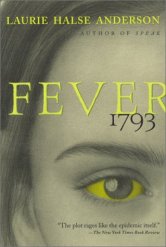
Fever 1793, by Laurie Halse Anderson

Fever 1793, by Laurie Halse Anderson. New York: Aladdin Paperbacks, 2002 (first published 2000). ISBN-10: 0689848919  ISBN-13: 978-0689848919.  272 p.

Plot Summary
Mattie Cook lives above her family's coffee shop with her mother and grandfather. During the summer of 1793, yellow fever breaks out in Philadelphia. Instead of spending her days avoiding chores, thinking of her friend Nathaniel Benson, and planning ways to make the coffee shop the best in Philadelphia, Mattie must learn how to survive in a city where disease is everywhere.

Critical Evaluation
School Library Journal's starred review of Fever 1793 declares that "readers will be drawn in by the characters and will emerge with a sharp and graphic picture of another world." Indeed, the story of Mattie's survival and maturation during one of the worst epidemics in American history is fascinating. Anderson succeeds in tying realistic descriptions of life in Colonial time with an interesting, well-written story. This book was selected as a Best Book for Young Adults by the ALA.

Reader’s Annotation
Mattie Cook lives above her mother's coffee house and dreams of her adult future. But when a yellow fever epidemic sweeps through Philadelphia, Mattie must grow up quickly as those close to her are affected. 

Author Information
Laurie Halse Anderson came up with the idea for Fever 1793 after she read an article in her local newspaper commemorating the Philadelphia epidemic 200 years ago. Anderson also wrote the novel Speak, which was a highly acclaimed finalist for the National Book Award and a Printz Honor book. Laurie lives in Pennsylvania with her husband and two daughters. She can be found online at her website, www.writerlady.com.

Anderson has said, "Fever 1793 for me started in a newspaper article that was written in 1993. Get it? Two hundred years, right? The Philadelphia Inquirer because I was living outside Philly. A museum exhibit had been put together that examined this epidemic that nearly wiped out the city when the city was the capital of the United States. And I'm a big history geek. And I had never heard about this epidemic. So I was reading the article and I was struck, (a) by that fact, that it was a little known, really important thing in American history. And it was disgusting. Yellow Fever's not a nice disease. It's very gory and you'd puke up blood and it was like people dying all over in the streets. And I realized that between the disgusting factor and the history thing, I had the perfect book for children."

Genre
Historical fiction

Curriculum Ties
History: Post-Revolutionary America; epidemics

Booktalking Ideas
-Maddie's crush on Nathaniel--how crushes are much the same today
-The description of Maddie's sickness striking her.

Reading Level/Interest Age
Grades 7-12.

Challenge Issues
None.

I chose this book because it is a common entry on lists of good historical fiction for young adults. Historical fiction seems to have fallen out of vogue for teens, so I wanted something written recently and this was a good pick.

Thursday, April 1, 2010

Evermore, by Alyson Noel

Evermore, by Alyson Noel. New York: St. Martin's Griffin, 2009. ISBN-10: 031253275X; ISBN-13: 978-0312532758. 320 p.

Plot Summary
After the car crash that killed her entire family and nearly killed her, Ever Bloom is able to read people's thoughts, see their auras, and know their whole life story just by touching them. She works hard to avoid other people and suppress her abilities, but when she meets Damen, everything changes. He has no aura, and his mind is a blank to her. As Ever grows closer to Damen, she finds she has more questions than answers about Damen's strange abilities.

Critical Evaluation
Evermore seems highly derivative of the Twilight phenomenon. Damen, like the vampire Edward, affects Ever strongly, and his touch is like no one else's. Damen has lightning-fast reflexes and has to deal with an unnaturally prolonged life, and it seems unclear why Ever affects him so strongly. But Noel's book succeeds in developing strong relationships between Ever and the people in her life, and it's refreshing to read a paranormal romance where the love interest isn't the sole focus of the protagonist's life (although it is still what the book spends the majority of its time on, sadly). While it will never be mistaken for an intellectual novel, Evermore will appeal to readers who loved Twilight and can't get enough of paranormal romance. Additional reader reviews can be found at goodreads.com.

Reader’s Annotation
Ever is a mind-reader who lost her family in a terrible accident. Although she isolates herself to suppress her powers, she can't hide herself enough to keep from falling in love with Damen. But Damen isn't a normal boy...he's an Immortal.

Author Information
Alyson Noel was born and raised in Orange County, CA. After high school she wanted to get away from suburbia, so she moved to Mykonos, Greece, where she lived for several years. She wrote her debut novel while she was a flight attendant, during long layovers and weather delays that kept her from home. She and her husband live in Newport Beach, CA. More information about Alyson and her books can be found at http://www.alysonnoel.com/.

What gave Noel the idea for her Immortals series? She says, "Grief. Pure and simple. I’d lost three people I loved in five months, and shortly after that I nearly lost my husband to leukemia (he’s in full remission now!). Experiencing that sort of intense grief and fear got me thinking a lot about life and death, mortality and immortality, the bonds that tie us even after a loved one is gone, and how our youth loving culture sort of seeks physical immortality by trying to remain youthful looking for as long as we can—and yet, what would happen if we really could achieve it? What would it mean for us, our loved ones, society in general? And since I’ve been interested in all things paranormal since I was a kid, Ever and Damen’s story seemed like the perfect vehicle to explore all of those themes."

Genre
Fantasy; paranormal romance

Curriculum Ties
None.

Booktalking Ideas
-Compare it to Twilight
-Ever's sadness at losing her family

Reading Level/Interest Age
High school.

Challenge Issues
Minimal. While Damen would like to have sex with Ever, she stops his advances before they go too far, and there are no other language or violence issues.

I included this book because it was included on YALSA's list of 2009 Teens' Top Ten Nominations. I wouldn't have picked it up otherwise. I can see why teens like it, but it definitely wasn't my cup of tea.