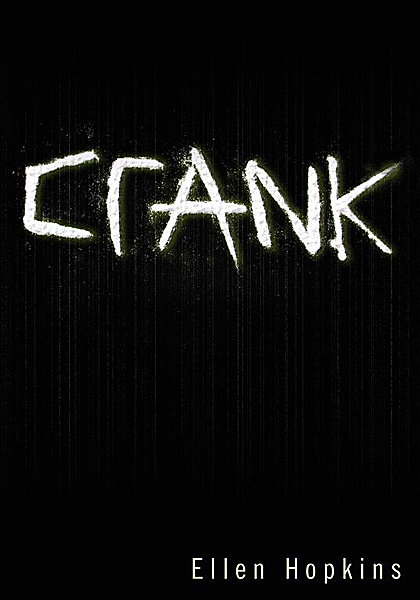
Crank, by Ellen Hopkins. New York: Simon Pulse, 2004. ISBN-10: 0689865198; ISBN-13: 978-0689865190. 544 p.
Plot Summary
Disillusioned by an underwhelming visit to her long-lost, addict father and her mom's relationship with a new boyfriend, Kristina starts a flirtation with a boy from her dad's apartment complex who introduces her to crystal meth. Once Kristina becomes addicted, she changes from a straight-A student to an addict who's willing to do anything to get her next fix. How low can crank take her before she hits rock bottom? What will it lead her to do and to become?
Critical Evaluation
This entire novel is written in verse. The conceit is jarring and disjointed at first, but within the first 20 pages it mostly feels natural and effectively distinguishes among dialogue, internal monologue and setting with a minimum of confusion (although at some points, it still feels gimmicky). Sometimes, the decision to use poetry separates the reader from the story, especially for readers who may not be used to reading poetry. Hopkins's language is spare and powerful, and her real-world emotions are shown effectively through what is, in effect, an autobiographical novel written from a mother's point of view.
Reader’s Annotation
Kristina was once a straight-A student. Now she's a drug addict. How did she fall so far?
Author Information
Born and adopted in Long Beach, California, Ellen grew up in Palm Springs, but currently lives in northern Nevada. She published her first poem when she was 9, and has been writing as long as she can remember. Her real life experiences with her daughter were what inspired her to write
Crank. Her daughter was also a meth addict, and Kristina's main storyline comes straight from experiences Hopkins had. Her website is
http://www.ellenhopkins.com/.
When
asked why she writes her novels in poetry, Hopkins says,
"I started CRANK in prose, but the voice was too angry. It was my voice, not “Kristina’s” voice. I’ve always written poetry and when I saw another verse novelist, Sonya Sones, speak at a conference, I knew it was the right way to tell the story. Verse is about how the poet views his or her world, and I wanted to view Kristina’s world. Verse allowed me inside her. Then I discovered a talent for it, and that many readers do like it."
Genre
Issue novel
Alternative format (poetry)
Curriculum Ties
Sociology: drug addiction
Booktalking Ideas
Do you know anyone who's addicted to drugs? Do you wonder how they got that way?
Reading Level/Interest Age
Grades 8+ (School Library Journal rating)
Challenge Issues
Where to start? Rape, drug use, swearing, sex, needles/mainlining, cutting, drug burnout, theft, addiction, teen pregnancy/promiscuity.
Challenge Defense
Share some interviews with Hopkins where she tells her daughter's story of addiction. Some interviews are found
here,
here,
here, and
here. Become very familiar with the book's content before recommending it.
I included this book because I see it on the bookshelves at Target. Since Target only really sells the bestsellers, I figured it was probably pretty popular (although I had never heard of it before). It was also an ALA Quick Pick for Reluctant Readers in 2005, as well as a Popular Paperback for Young Adults.