Showing posts with label *genre: historical fiction. Show all posts

Tuesday, May 11, 2010

The Evolution of Calpurnia Tate, by Jacqueline Kelly

The Evolution of Calpurnia Tate, by Jacqueline Kelly. New York: Henry Holt and Co., 2009. ISBN-10: 0805088415; ISBN-13: 978-0805088410. 340 p.

Plot Summary
The summer of 1899 is a hot one in Texas. Calpurnia Tate is the only daughter of even children, and to keep cool she spends a lot of time at the river with her grandfather. An avid naturalist, he helps Calpurnia develop a love of nature and the sciences of biology and botany. But Calpurnia, as a girl at the turn of the century, is expected to spend her time learning to cook doing needlework, and learning the other feminine skills she will need before she comes out as a debutante. Can Calpurnia balance her duties as the family's only daughter with her ambition and scientific temperament?

Critical Evaluation
Calpurnia Tate is a delightful character. Kelly does an excellent job at evoking a specific time period, from the excitement surrounding the first telephone and automobile in town to the time-consuming nature of household chores like laundry and cooking. I loved this book, although I was a little disappointed that Calpurnia's questions about how to balance her desires with others' expectations wasn't really answered. Part of the appeal of this story, I think, is that it tries to answer her questions in a realistic way--just because she wants to be a botanist doesn't mean it will really be possible for her in 1899 society, but she's going to try her best to make it happen. Calpurnia's strong voice and determined interests make this story fly by.

Reader’s Annotation
The summer of 1899 is hot in Texas, and Calpurnia Tate spends her time learning about biology and botany from her naturalist grandfather. But as a girl, can Calpurnia balance her scientific curiosity with the expectations of womanly behavior?

Author Information
Jacqueline Kelly was born in New Zealand but raised in Canada. She moved to Texas to attend college in El Paso, then went to Galveston to complete medical school. (It's obvious that her time in Texas intimately influenced the setting and details of Calpurnia Tate). She practiced medicine for many years, but then decided it was time for a career change and attended law school at the University of Texas. After practicing law for a few years, she decided to spend her time writing fiction instead (source). The Evolution of Calpurnia Tate is her debut novel, and was a Newbery Honor book.

When asked about her writing process, Kelly shared the following: "This book was inspired by a summer sojourn in my big old 120-year-old farmhouse in Fentress, Texas. With the thermometer almost boiling over, I began to wonder how people stood the heat a hundred years ago with no air conditioning, especially since they had to wear all those clothes. Callie and her entire family sprang to life at that moment. The book was also inspired by the sight of a big yellow grasshopper and a small green grasshopper sunning themselves on one of the window screens. They looked so different that I wondered if they were different species or not. I spent a lot of time trying to figure this out but never could.  Alas, the grasshoppers have refused an interview....I wrote a lot of this novel longhand, sitting on an old cushion on the front steps in Fentress, like Callie making her morning list of creatures" (source).

Genre
Historical fiction

Curriculum Ties
History: Early 1900s American life
Science: History of scientific theories, the ways science was practiced 100 years ago

Booktalking Ideas
Describe the setting--first telephone, first car, first time Calpurnia makes her own apple pie. The setting is so different from today that it will interest booktalking listeners.

Reading Level/Interest Age
Amazon says that this book will really appeal to 9-12 year olds, but I think that the language may be a little difficult for younger readers to get through. I feel strongly that this book could appeal to the older teen reader--while Calpurnia is a younger protagonist, her concerns can still resonate strongly with today's teen girls.

Challenge Issues
None.

I included this book because it appeared on the ALA's 2010 Best Books for Young Adults list. It also sounded really interesting in reviews I've read in various places on the Web.

The Amazing Adventures of Kavalier and Clay, by Michael Chabon

The Amazing Adventures of Kavalier and Clay, by Michael Chabon. New York: Picador, 2000. ISBN-10: 0312282990; ISBN-13: 978-0312282998. 656 p.

Plot Summary
Joe Kavalier, a Jewish art and practitioner of Houdini-esque escape, has just managed to escape Nazi-occupied Prague and moved to New York City. His cousin Sammy Clay, a Brooklyn-based comic book writer, chooses Kavalier as his partner in the development and production of this new novelty art form. Together, they create such characters as The Escapist, the Monitor, and Luna Moth (inspired by Rosa Saks, a woman who will influence both men throughout their lives). As they navigate life during World War II, they attain amazing professional success, but have more difficulty with their personal lives.

Critical Evaluation
From the first pages of this ambitious noel, it's clear the reader is in the hands of a master. CNN.com describes it as a "grand novel about dreamers selling dreams, reminding us that part of the thrill of dreaming is not the dream itself, but the realization that we can dream" (link). New York magazine's review admits, "I'm not sure what the exact definition of a 'great American novel' is, but I'm pretty sure that Michael Chabon's sprawling, idiosyncratic, and wrenching new book is one." At turns melancholy, joyful, and nostalgic for the Golden Age of comics, Chabon's Pulitzer Prize-winning novel is a gem.

Reader’s Annotation
Jo Kavalier and Sammy Clay are comic book artists living in 1940s New York. As they help build comic books as an art form, they grow up and deal with emotions of love, jealousy, and hatred as they work together.

Author Information

Michael Chabon was born in Washington, D.C., and grew up in the suburbs of Columbia, Maryland. He deeply loved comic books as a boy--his grandfather had been a typographer at a plant where comic books were printed, and would bring home bags of free comics for Chabon's father. His dad thought it was normal that his son should also grow up reading comic books (source). While working on a masters' program at UC Irvine, his thesis was the manuscript for Mysteries of Pittsburgh. Chabon didn't know it, but his thesis advisor submitted it to several publishing houses, and it was accepted for an advance of $155,000 (a colossal sum for a first novel by an unknown author). Chabon is married to the author Ayelet Waldman, and they and their four children live in Berkeley, CA.

In an interview with Powell's Books, Chabon said, of Kavalier and Clay, that "I definitely had a desire to try something bigger, but I've had that desire for a while. I'd tried once before to do this kind of a book. After I wrote The Mysteries of Pittsburgh, I worked on a novel called Fountain City for more than five years. Like this book, it had multiple points of view and took place over a fairly long period of time; it changed locales from one continent to another, all those kinds of things. And I failed. I had to abandon it....I wanted to do something more ambitious. Jonathan Yardley's review of Wonder Boys in The Washington Post was very kind and generous - he liked the book - but he closed the review with a paragraph where he sort of clapped his hand on my shoulder and said, "You've done well, but you haven't really tried much. Now's the time to set your sights higher." I took that to heart. It chimed with my own thoughts. I had bigger ambitions" (source). The critical reception of this novel, and the Pulitzer Prize he won, prove that his larger ambitions were brilliantly realized.


Genre
Historical fiction.
Adult crossover.

Curriculum Ties
History: 1940s New York City. Comic book history.

Booktalking Ideas
-Connect popular comics/superheroes (Batman, Spider-man, Superman) to this era of comic development. A lot of real artists are interspersed with fictional characters in the book.

Reading Level/Interest Age
Grades 10+

Challenge Issues
Sexual situations, including homosexuality. Some language.

I included this book because it's one of my favorites, and though it's an adult novel, I feel that many teens will also enjoy it. With the recent popularity of comic books (and especially movie adaptations of favorite comic characters), I feel that it will interest readers who like such movies.

Wednesday, April 7, 2010

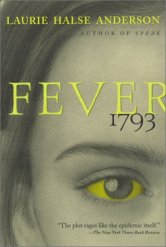
Fever 1793, by Laurie Halse Anderson

Fever 1793, by Laurie Halse Anderson. New York: Aladdin Paperbacks, 2002 (first published 2000). ISBN-10: 0689848919  ISBN-13: 978-0689848919.  272 p.

Plot Summary
Mattie Cook lives above her family's coffee shop with her mother and grandfather. During the summer of 1793, yellow fever breaks out in Philadelphia. Instead of spending her days avoiding chores, thinking of her friend Nathaniel Benson, and planning ways to make the coffee shop the best in Philadelphia, Mattie must learn how to survive in a city where disease is everywhere.

Critical Evaluation
School Library Journal's starred review of Fever 1793 declares that "readers will be drawn in by the characters and will emerge with a sharp and graphic picture of another world." Indeed, the story of Mattie's survival and maturation during one of the worst epidemics in American history is fascinating. Anderson succeeds in tying realistic descriptions of life in Colonial time with an interesting, well-written story. This book was selected as a Best Book for Young Adults by the ALA.

Reader’s Annotation
Mattie Cook lives above her mother's coffee house and dreams of her adult future. But when a yellow fever epidemic sweeps through Philadelphia, Mattie must grow up quickly as those close to her are affected. 

Author Information
Laurie Halse Anderson came up with the idea for Fever 1793 after she read an article in her local newspaper commemorating the Philadelphia epidemic 200 years ago. Anderson also wrote the novel Speak, which was a highly acclaimed finalist for the National Book Award and a Printz Honor book. Laurie lives in Pennsylvania with her husband and two daughters. She can be found online at her website, www.writerlady.com.

Anderson has said, "Fever 1793 for me started in a newspaper article that was written in 1993. Get it? Two hundred years, right? The Philadelphia Inquirer because I was living outside Philly. A museum exhibit had been put together that examined this epidemic that nearly wiped out the city when the city was the capital of the United States. And I'm a big history geek. And I had never heard about this epidemic. So I was reading the article and I was struck, (a) by that fact, that it was a little known, really important thing in American history. And it was disgusting. Yellow Fever's not a nice disease. It's very gory and you'd puke up blood and it was like people dying all over in the streets. And I realized that between the disgusting factor and the history thing, I had the perfect book for children."

Genre
Historical fiction

Curriculum Ties
History: Post-Revolutionary America; epidemics

Booktalking Ideas
-Maddie's crush on Nathaniel--how crushes are much the same today
-The description of Maddie's sickness striking her.

Reading Level/Interest Age
Grades 7-12.

Challenge Issues
None.

I chose this book because it is a common entry on lists of good historical fiction for young adults. Historical fiction seems to have fallen out of vogue for teens, so I wanted something written recently and this was a good pick.

Sunday, March 14, 2010

Fallen Angels, by Walter Dean Myers

Fallen Angels, by Walter Dean Myers. New York: Point, 1988. ISBN-10: 0545055768; ISBN-13: 978-0545055765. 309 p.

Plot Summary
Richie, Lobel, Johnson, Brunner, and Peewee are all young soldiers in Vietnam. They all joined the army for different reasons: one sends extra money home to his mom so his little brother can finish high school, and another joined because he didn't think there would be any fighting and it would be an easy job. They all have different stories, but they share the same purpose--they all want to get home alive.

Critical Evaluation
This novel's first-person point of view lends it a sense of real tension and doom as Richie's tour of duty nears its close. Myers excels at painting portraits of young men, the same age as many teen readers, who are pressed into duty in a controversial, hellish war. Astute teens will be able to draw parallels between the Vietnam War and today's conflicts in Iraq and Afghanistan. In this book, the problems of war become real, and Myers does a good job of portraying believable examples of teens dealing with issues such as a loss of innocence and the unromantic reality and moral ambiguity of war.

Reader’s Annotation
Richie went to Vietnam in the army because he didn't get into college. During his time there, he finds out how hellish war can really be.

Author Information
Walter Dean Myers was born in Martinsburg, West Virginia in 1937, but was raised in Harlem. He dropped out of high school and joined the army on his seventeenth birthday. His army experiences lend real color and authenticity to his writings on the Vietnam War. Before he left high school, one of his English teachers told him to keep on writing no matter what else happened to him. He took her advice and has published over 70 novels for children and young adults. A full list of his books, as well as other author information, can be found at http://www.walterdeanmyers.net/biblio.html.

Genre
Historical fiction

Curriculum Ties
History: Vietnam War, 1960s race relations

Booktalking Ideas
-Where do you picture yourself when you're 18? In this novel, 18-year-old boys are at war.
-fear of premature death
-people hardening in the face of war

Reading Level/Interest Age
Grades 9-12

Challenge Issues
Language, war violence and mature themes


Challenge Defense
Point to the novel as a realistic portrayal of the war by looking at history books and other primary source documents from the era.

I included this book because it won the ALA's Coretta Scott King award in 1989, and because I needed some historical fiction to round out the genres included in this blog.