Showing posts with label adult crossover. Show all posts

Tuesday, May 11, 2010

The Amazing Adventures of Kavalier and Clay, by Michael Chabon

The Amazing Adventures of Kavalier and Clay, by Michael Chabon. New York: Picador, 2000. ISBN-10: 0312282990; ISBN-13: 978-0312282998. 656 p.

Plot Summary
Joe Kavalier, a Jewish art and practitioner of Houdini-esque escape, has just managed to escape Nazi-occupied Prague and moved to New York City. His cousin Sammy Clay, a Brooklyn-based comic book writer, chooses Kavalier as his partner in the development and production of this new novelty art form. Together, they create such characters as The Escapist, the Monitor, and Luna Moth (inspired by Rosa Saks, a woman who will influence both men throughout their lives). As they navigate life during World War II, they attain amazing professional success, but have more difficulty with their personal lives.

Critical Evaluation
From the first pages of this ambitious noel, it's clear the reader is in the hands of a master. CNN.com describes it as a "grand novel about dreamers selling dreams, reminding us that part of the thrill of dreaming is not the dream itself, but the realization that we can dream" (link). New York magazine's review admits, "I'm not sure what the exact definition of a 'great American novel' is, but I'm pretty sure that Michael Chabon's sprawling, idiosyncratic, and wrenching new book is one." At turns melancholy, joyful, and nostalgic for the Golden Age of comics, Chabon's Pulitzer Prize-winning novel is a gem.

Reader’s Annotation
Jo Kavalier and Sammy Clay are comic book artists living in 1940s New York. As they help build comic books as an art form, they grow up and deal with emotions of love, jealousy, and hatred as they work together.

Author Information

Michael Chabon was born in Washington, D.C., and grew up in the suburbs of Columbia, Maryland. He deeply loved comic books as a boy--his grandfather had been a typographer at a plant where comic books were printed, and would bring home bags of free comics for Chabon's father. His dad thought it was normal that his son should also grow up reading comic books (source). While working on a masters' program at UC Irvine, his thesis was the manuscript for Mysteries of Pittsburgh. Chabon didn't know it, but his thesis advisor submitted it to several publishing houses, and it was accepted for an advance of $155,000 (a colossal sum for a first novel by an unknown author). Chabon is married to the author Ayelet Waldman, and they and their four children live in Berkeley, CA.

In an interview with Powell's Books, Chabon said, of Kavalier and Clay, that "I definitely had a desire to try something bigger, but I've had that desire for a while. I'd tried once before to do this kind of a book. After I wrote The Mysteries of Pittsburgh, I worked on a novel called Fountain City for more than five years. Like this book, it had multiple points of view and took place over a fairly long period of time; it changed locales from one continent to another, all those kinds of things. And I failed. I had to abandon it....I wanted to do something more ambitious. Jonathan Yardley's review of Wonder Boys in The Washington Post was very kind and generous - he liked the book - but he closed the review with a paragraph where he sort of clapped his hand on my shoulder and said, "You've done well, but you haven't really tried much. Now's the time to set your sights higher." I took that to heart. It chimed with my own thoughts. I had bigger ambitions" (source). The critical reception of this novel, and the Pulitzer Prize he won, prove that his larger ambitions were brilliantly realized.


Genre
Historical fiction.
Adult crossover.

Curriculum Ties
History: 1940s New York City. Comic book history.

Booktalking Ideas
-Connect popular comics/superheroes (Batman, Spider-man, Superman) to this era of comic development. A lot of real artists are interspersed with fictional characters in the book.

Reading Level/Interest Age
Grades 10+

Challenge Issues
Sexual situations, including homosexuality. Some language.

I included this book because it's one of my favorites, and though it's an adult novel, I feel that many teens will also enjoy it. With the recent popularity of comic books (and especially movie adaptations of favorite comic characters), I feel that it will interest readers who like such movies.

Monday, May 10, 2010

Christine, by Stephen King

Christine, by Stephen King. New York: Signet, 1983. ISBN-10: 0451160444; ISBN-13: 978-0451160447. 528 p.

Plot Summary
Arnie is a loser. Every high school has at least two--a girl and a boy--and he's the boy at Libertyville High. He's too scrawny to fit in with the jocks, doesn't fit in with the intellectuals because he has no specialty, even though he's smart, and out with the girls because of terrible acne. But Artie is great with one thing--cars. When he sees an old junker, a 1958 Plymouth Fury, on the side of the road with a For Sale sign hanging in the window, it's love at first sight. But the car, Christine, isn't just a car. She's possessed--and out for blood.

Critical Evaluation
Stephen King is often called the Master of Horror, and this book is a stellar example showcasing King's skills at creating setting and developing his characters. King's earlier works--including Carrie, Cujo, The Shining, 'Salem's Lot, and Christine, are especially effective examples of the horror genre done well. A creeping sense of horror builds as King slowly sets the scene, and the buildup pays off at the tense, transfixing climax of Christine's reign of terror.

Reader’s Annotation
Arnie is a loser whose only real talent is working with mechanical things--especially cars. When he first sees Christine, a 1958 Plymouth Fury in terrible condition, it's love at first sight. Yet, as Artie restores Christine to mint condition, it becomes clear that Christine is more that just a car--she's a killing machine, and she's out for blood.

Author Information
Stephen King is renowned for his skill at writing horror. Born in Portland, Maine, he graduated from the University of Maine at Orono, where he met his wife, Tabitha (they married in 1971). Although Stephen was qualified to teach English at the high school level, he was unable to find work as a teacher after graduation, so he worked at an industrial laundry while his wife worked at Dunkin' Donuts. He still found time to write, despite an exhausting job, and eventually was employed by a high school in Hampden, Maine. He sold his first novel, Carrie, and the paperback rights sold for a very nice price that enabled him to begin working full-time. Since the publication of Carrie, he has published nearly 80 books, mainly novels and short-story collections (A complete list of all his publications can be found at his personal website.). He and his wife have three children, and they live in Maine. More biographical details can be found at StephenKing.com.

King has been vocal in his support of building bridges between popular and literary fiction. In an interview at Powell's.com, he explains that "there's a whole range of people who are doing really, really good work, that we call popular fiction. First of all, it's an artificial distinction between literary fiction and popular fiction. I sometimes think that literary fiction is a term that writers and critics give to a certain kind of well-written fiction that doesn't sell very much. That's the criteria, and a certain prejudice kicks in against you if you do sell a lot of books. The way the prejudice works, it's never scathing, outright, but it goes something like this: If three million people are reading X, I don't really need to read X to know that that is a bad writer's work. Because all I do is divide three million by the average IQ and come out with a minus number, and that's the IQ of people reading that book. That's bullshit, is all, it's just bullshit" (link). As a writer of popular fiction, he tries never to dismiss his readers because of what they like to read, and wishes that the media establishment would do the same.

Genre
Horror
Adult crossover

Curriculum Ties
None

Booktalking Ideas
-Read intro to Arnie as a character, especially the ways he doesn't fit in with any of the groups at his high school.
-Read the hallucination Dennis (Arnie's best friend) has when he first sits in Christine. He hallucinates that the car is in mint condition, with Christine telling him to take a drive, and it freaks him out.

Reading Level/Interest Age
Grades 9-12

Challenge Issues
Language, graphic violence, disrespect for parents/elders

I included this book because King's early novels, many about the horrors of high school (especially Carrie and Christine) are appealing to teens who are ready to move past the sterile, short horror novels meant for high school students (such as books by authors like R.L. Stine and Christopher Pike). I love Stephen King and I thought Christine was a perfect choice to recommend as a good adult crossover, specifically because its descriptions of high school as a horrible place for those who don't fit in. It's an appealing notion.

Thursday, March 18, 2010

Lucky, by Alice Sebold

Lucky, by Alice Sebold. New York: Little, Brown and Co., 1999. ISBN-10: 0316096199; ISBN-13: 978-0316096195. 246 p.

Plot Summary
In this memoir, the acclaimed author of The Lovely Bones reveals how her life was transformed when she was brutally raped and assaulted as an 18-year-old college freshman. A policeman, attempting to be kind, told her she was lucky--at least she hadn't been raped and them dismembered, as had happened to another girl in the same place.  Sebold details the aftermath, from the reactions of her friends and family to the trial the subsequent verdict of her rapist, her post traumatic stress and heroin addiction to a final sense of understanding.

Critical Evaluation
Sebold speaks with an openness that is sometimes unbearable as she describes her rape and assault in searing detail. This candid memoir illuminates the experiences trauma victims face with wit and black humor. Though the book was intended for an adult audience, it is relevant to teens who may be facing the effects of sexual assault in their own lives or the lives of those they love. This is an essential read for anyone looking for a firsthand account of the real effects of sexual assault.

Reader’s Annotation
When she was an 18-year-old college freshman, author Alice Sebold was raped and beaten in a park outside her college campus. Sebold details her recovery from a traumatic event in this gripping memoir.

Author Information
Alice Sebold was born in 1963 in Wisconsin and grew up in Pennsylvania. She attended Syracuse University and studied writing. She later went to Texas and the UC-Irvine for graduate school (source). Lucky was her first published book, followed by The Lovely Bones and The Almost Moon. She lives in Irvine, CA.

On the last day of her freshman year of college, Sebold was attacked and raped in a park near her dorm. After months at home, where she returned at the urging of her parents, she returned to Syracuse and finished her degree. Months after her rape, she recognized her rapist on a street near campus and secured his arrest and subsequent conviction with a maximum sentence. Lucky details this ordeal.

Genre
Memoir

Curriculum Ties
Sociology: rape, women's studies

Booktalking Ideas
-Do you know anyone who has been raped? Do you want to understand what they're going through?
-read description of the fear Sebold feels as she realizes she's alone in the park and there is a huge man there.

Reading Level/Interest Age
Grades 11-12. Some younger students may also be interested, dependent on emotional maturity, but it is probably too explicit in its detailed description of Sebold's rape for many.

Challenge Issues
Detailed description of a rape and assault and the subsequent medical exam at the police station.

Challenge Defense
Be very familiar with the book before recommending it to a teen. Remind concerned parents that it is a real memoir and may help some teens.

I included this book because I loved it when I first read it and felt it could be relevant to the experiences many teens may face.

Sunday, March 7, 2010

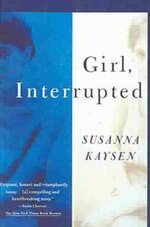
Girl, Interrupted, by Susanna Kaysen

Girl, Interrupted, by Susanna Kaysen. New York: Turtle Bay Books, 1993. ISBN-10: 0679746048; ISBN-13: 978-0679746041. 173 p.

Plot Summary
In 1967, after meeting with a doctor she had never seen before, 18-year-old Susanna Kaysen committed herself to the McLean Mental Hospital for what would turn into a two-year stay. Kaysen describes her time at the hospital through her own experiences and those of her fellow patients.

Critical Evaluation
Kaysen's book is an important historical document looking at the reality of treatment for mental illnesses in the late 1960s. This memoir doesn't proceed chronologically; instead, it presents a series of vignettes, including images of Kaysen's admissions paperwork and other notes taken by nurses at the facility. Kaysen's expert descriptions of how madness feels and how it is treated are instructive, although her detachment may alienate some viewers who seek to be able to relate to a narrator. It may be interesting to teens who have suffered from mental illnesses, especially as it shows how treatments have changed in the last 40 years. It may appeal to readers who enjoyed Sylvia Plath's "The Bell Jar."

Reader’s Annotation
Susanna Kaysen was committed to a mental hospital when she was 18. She was there for two years. Read her autobiographical account of her time there.

Author Information
Susanna Kaysen was born and raised in Cambridge, Massachusetts. Her father, Carl Kaysen, was an MIT professor and advisor to President John F. Kennedy. When she was 18, she underwent psychiatric treatment for depression after a diagnosis of borderline personality disorder. This experience is the basis for Girl, Interrupted.

Her most recent book, The Camera My Mother Gave Me, is a memoir published in 2001. She was interviewed about her newest book by the Austin Chronicle in 2001, and another Q&A can be found at her publisher's website.

Genre
Memoir

Curriculum Ties
Psychology

Booktalking Ideas
What really goes on in a mental hospital?
How does insanity feel to the person going insane?

Reading Level/Interest Age
Grades 9-12

Challenge Issues
Frank language and discussions of sex.


Challenge Defense
It may be helpful to point challengers to reviews of the book at two different mental health websites: Psychiatry Online, and Mental Help.net. The librarian should also be very familiar with the book's contents before recommending it to younger teens.

I included this book because it was selected as an ALA Best Book for Young Adults in 1994. I also needed more nonfiction on my blog, and this book has been on my to-read list for months.